General information from published guidance, not a diagnosis or medical advice for your baby. If you are worried, call your doctor, midwife or local health line, whatever this page says. In an emergency, call your local emergency number.
Sleep at your baby's age
Typical ranges. Healthy babies vary a lot.
Choose by birthday
Sleep in 24 hours
14-17 hours
Longest stretch
2-4 hours
Sleep is spread evenly over day and night because small stomachs need feeding every few hours.4678
Sleep in 24 hours
14-17 hours
Longest stretch
Getting longer at night (varies a lot)
Night sleep starts to get longer. Daylight, play by day and dark, quiet nights help the body clock develop.4678
Sleep in 24 hours
12-16 hours
Longest stretch
5-8 hours for some babies
Sleep becomes more regular. Many babies still wake at night to feed, and that is normal.57
Safe sleep check
A quick reminder list based on AAP and NHS safe sleep advice. Your answers stay on your phone.
0 of 11 ticked
Start a sleep timer from Ella with one tap, or from the widget and lock screen on Android, and see the day's sleep.Open Ella
Get medical help now if
your baby stops breathing for 20 seconds or more, or has pauses in breathing and turns blue, grey or pale, or goes floppy101213
your baby is very hard to wake, floppy, or not interested in feeding310
your baby is working hard to breathe: grunting, ribs or tummy pulling in, or very fast breathing10
Call your doctor or midwife today if
your newborn regularly sleeps through feeds in the first 2 weeks8
your baby snores or breathes noisily most nights, or you are worried about their breathing10
your baby is never settled and cries most of the time they are awake11
If your baby stops breathing, turns blue or grey, is floppy or cannot be woken, call your local emergency number now.
The details
Why newborns wake so often
A newborn's stomach holds only a little milk, and their body clock doesn't work yet. Waking every 2-4 hours is how they get enough to eat. It is normal, and it doesn't mean anything is wrong with the way you settle them.
Most newborns sleep as much by day as by night. Help the body clock along: open the curtains and talk and play during the day, and keep night feeds dark, quiet and boring. Your baby will gradually learn that night-time is for sleeping, and sleep usually becomes more regular by around 4 months.
The AAP recommends room-sharing without bed-sharing, because sharing a bed raises the risk of sudden infant death. If you might fall asleep with your baby, the NHS advises making the bed as safe as possible: a firm mattress, no pillows or covers near the baby, no gaps where the baby could get stuck, and never after alcohol, drugs or smoking, or medicines that make you drowsy, or if your baby was premature or small at birth. Never fall asleep with your baby on a sofa or armchair. Never swaddle a baby in an adult bed.
A swaddle can calm a newborn, but wrap the arms snugly and the hips loosely so the legs can bend up and out. Always place a swaddled baby on their back, and stop swaddling as soon as your baby tries to roll.
Newborns sleep a lot, but they should wake for feeds: at least 8 feeds in 24 hours in the first weeks. If your baby is very sleepy or not gaining weight well, don't wait too long between feeds, even if it means waking them. A baby who is very hard to wake, floppy, or not interested in feeding needs to see a doctor.
There is a wide range. Some babies sleep 5-8 hours at night by 3-6 months, but not all, and waking at night is still normal well into the first year.67
Can my newborn sleep on their side?
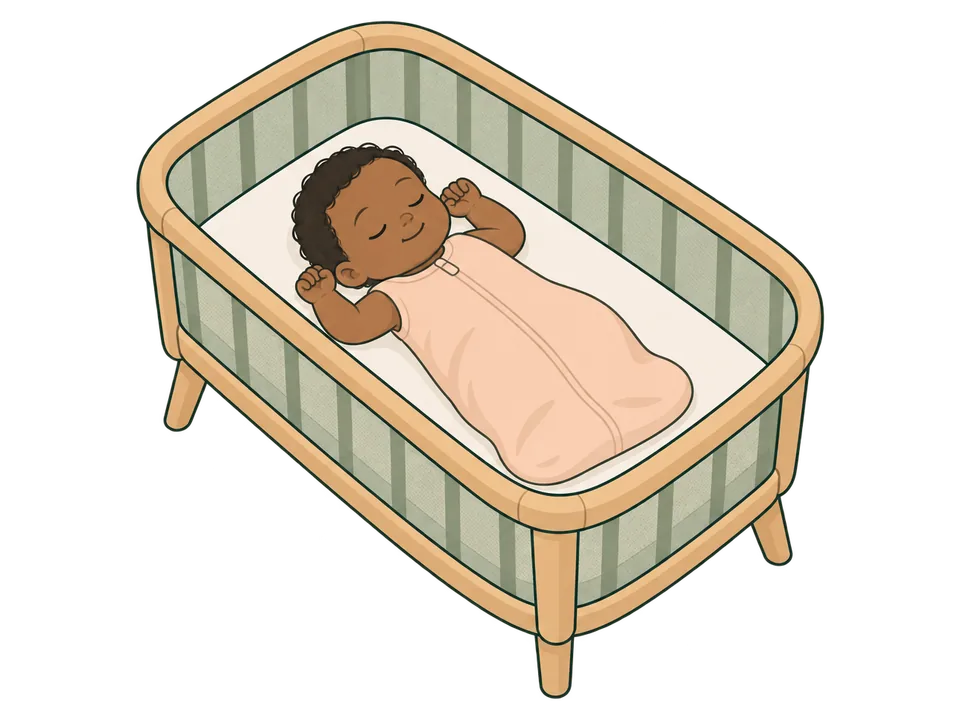
No. The back is the only safe position for sleep until your baby can roll both ways on their own. Then you can leave them in the position they choose.13
Is it OK for my baby to sleep in the car seat?
Only while traveling, with the straps done up. Once you arrive, move your baby to a flat crib or bassinet if they are still asleep.13
Should I use a pacifier at night?
Offering a pacifier at sleep time is linked to a lower risk of sudden infant death. If you breastfeed, wait until breastfeeding is going well, usually after the first few weeks. Don't force it, and don't put it back in once your baby is asleep.12
How many naps does a newborn need?
Newborns don't have real naps yet: they drift in and out of sleep around the clock, often only 1-2 hours at a time. Regular sleep cycles usually develop around 4 months, and a more predictable nap pattern follows.6
Ella
Watch the sleep pattern appear
Start a sleep timer in Ella with one tap (on Android, also from the widget or lock screen). Ella's rhythm chart shows when your baby really sleeps, and your partner sees it too.
Guidance can differ between countries. Where it does, we show both. Follow your own doctor or health service.
Checked against current guidance on October 8, 2026. General information, not medical advice. Written by the Ella team at Muchita AI from published guidance by the AAP, NHS, NICE, WHO and CDC, with AI-assisted drafting and translation checked against those sources by our team. These organisations have not reviewed or endorsed this page. General information, not a diagnosis or medical advice. If you are worried about your baby, trust your instinct and call a doctor.