A guide for parents · WHO Child Growth Standards
Baby growth percentiles, made understandable
A percentile tells you where a measurement sits on a growth chart. Explore weight, length and height with official WHO data, then keep the measurements together in Ella.
Sources checked October 4, 2026 · By Ella, Muchita AI
What does the 30th percentile mean?
For weight-for-age, the 30th percentile means that about 30 out of 100 children of the same age and sex in the reference have a lower weight. About 70 have a higher weight. The same idea applies to length or height, using that measurement instead.
It does not mean 30% of an ideal weight. Percentiles are positions in a reference distribution, not scores for health or parenting. The 50th percentile is the middle of the reference, not a goal every baby should reach.
About 30 smaller measurements
About 70 larger measurements
Weight for age
How does this weight compare at this age?
Compare weight with children of the same age and sex in the WHO reference. It does not account for how long or tall the child is.
Length or height for age
How does this length or height compare at this age?
Compare length or height with children of the same age and sex. Babies are measured lying down; older children are measured standing.
Weight for length or height
How does this weight compare at this length or height?
Compare weight with children of the same length or height and sex. This is a separate calculation, not the difference between two age percentiles.
Explore your baby's measurements
Enter measurements or try the fictional example. Results update as you type. This calculator uses WHO standards from birth to under 60 months; it is an educational comparison, not a diagnosis.
Your measurements stay in this page's memory. They are not saved or sent to Ella, and are not included when you share the guide.
Fictional example - not your baby's measurements
Weight for age
Enter an age, select a chart, and add a weight or length to see the comparison.Length or height for age
Enter an age, select a chart, and add a weight or length to see the comparison.Weight for length or height
Enter an age, select a chart, and add a weight or length to see the comparison.Move over the chart, tap a point, or use the sliders below to explore. With the chart focused, arrow keys move the exploration point. Exploration does not change your entered measurements.
Reference curves: 3, 15, 50, 85 and 97 percentiles
Length and standing-height curves are separate at day 731. The change of measurement method is not a sudden loss of growth.
Explore a point
Exploration point - an illustration, not a new measurement
Chart values as a table
| Age or length | Measurement | Percentile |
|---|
How to read a growth chart
On an age chart, find the child's age along the bottom and the measurement up the side. Their intersection is a point. The curved lines show reference percentiles as age changes. A point near the 50 line is close to the middle of that reference.
For weight-for-length, the bottom axis is length, not age. Find the measured length along the bottom and weight up the side. Hover or tap the interactive charts above to see which comparison each point represents.
A point between the 15 and 50 lines is between those reference percentiles. It is not necessarily halfway between their numbers: the calculator uses the underlying WHO data. The lines shown here are reference positions, not boundaries between healthy and unhealthy children.
Why weight relative to length matters
Two babies can have the same weight but different lengths. Their weight-for-age rank can be the same if their age and chart sex are the same, while their weight-for-length ranks differ. A longer baby is compared with a different part of the length-based reference.
You cannot calculate this by subtracting the height percentile from the weight percentile, dividing the two ranks, or taking their average. Enter the actual weight and measured length or height together. WHO supplies a separate weight-for-length or weight-for-height table.
Try the example below. The chart sex and weight stay fixed while you change length. Each result comes from the official weight-for-length table. It illustrates the comparison; it does not tell you to change a baby's feeding.
Same weight, different lengths
Fictional boys, weight 7 kg, lying length. Only length changes.
At 64 cmWeight-for-length: Growth percentile: 48.2
At 70 cmWeight-for-length: Growth percentile: 1
Length and height are different measurements
Length is measured lying down, ideally with a proper infant length board and someone helping position the head and legs. Standing height is measured upright without shoes. A tape placed along a wriggling baby is not interchangeable with a carefully taken clinic measurement.
WHO uses lying length for younger children and standing height from around age 2. This calculator follows WHO's daily tables: length through day 730, standing height from day 731. For a standing measurement at days 274-730 it adds 0.7 cm; for lying length from day 731 it subtracts 0.7 cm. It shows the conversion instead of hiding it.
Before 274 days, enter a lying-length measurement. For weight, use a suitable scale and record the units and date. Use weight and length measured at the same visit when comparing weight for length. Small measurement errors can change the calculated rank, especially in young babies.
Look at the pattern, not one number
A growth chart is more useful when several reliable measurements are considered together. One point cannot explain a child's health, feeding or development. Your clinician looks at the pattern, the quality of the measurements and the child's wider situation.
A percentile change can have several explanations, including a different measurement technique, an incorrect age, a switch of reference charts or a real change in growth. Keep consistent records and discuss a change or concern with your clinician. Do not use this calculator alone to decide whether to increase or restrict feeds.
What if my baby was born prematurely?
Calendar age counts time since birth. Corrected age accounts for being born before the expected term. Premature babies may need a different reference and age choice; the WHO study used to develop these standards excluded births before 37 weeks.
Ask your clinician which chart and age to use. If they give you a corrected age in days for a WHO comparison, you can enter it and mark it as clinician-provided. The calculator does not calculate an age correction or decide when it should stop. Ella's due-date features and correction rules are separate app behavior, not a universal clinical rule.
Why might a clinic show a different percentile?
The reference, exact age, chart sex and measurement method must match before two results can be compared. WHO's Child Growth Standards are an international reference; the language you read does not change these data.
In the United States, CDC recommends WHO charts from birth to age 2 and CDC charts from age 2 onward. This tool continues to use WHO data up to under 60 months and is labelled accordingly. Your clinician may use the reference recommended in your country. A change of chart or a switch from lying length to standing height can change the rank.
Track weight in Ella and see the comparison automatically
The calculator explains one set of measurements. Ella keeps your baby's measurements over time, so you can look back at the growth pattern without re-entering everything.
- Add your baby's date of birth and sex for the reference chart in the baby details.
- Log a weight with its date and units. Add a reliable length or height from the same day for a weight-for-length or weight-for-height comparison.
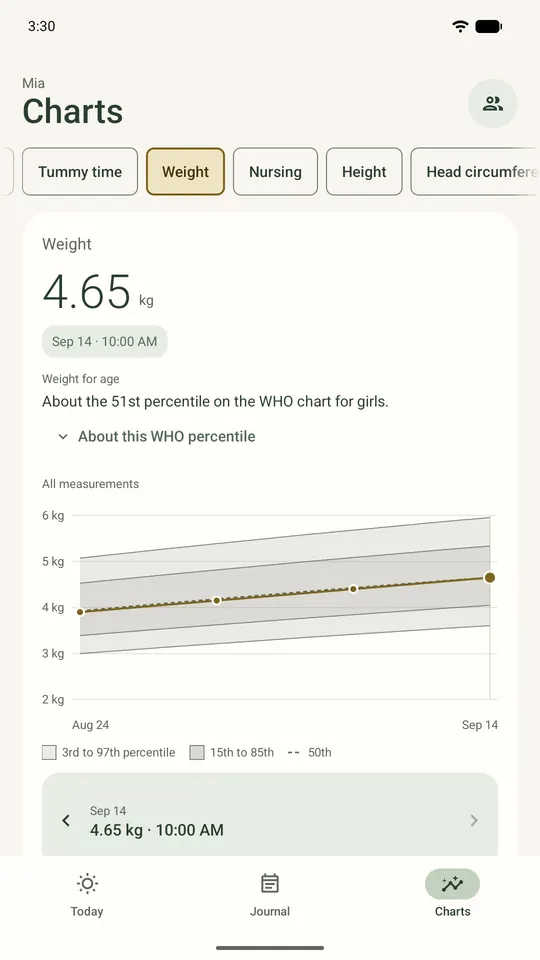
- Open Charts on Android or in the web companion, choose Weight or Height, and select a recorded point. Ella shows the WHO comparison automatically when the required details are available.
- Review the measurement history and WHO source explanation. Weight-for-length or height uses a verified same-baby measurement from the same day; an entry awaiting review is not used for that comparison.
These growth comparisons are available on Android and the web. Android is in early access. The iPhone app is coming soon; you can use the web companion in Safari. Ella infers length or height from age rather than asking the posture of each measurement. Ask your clinician about premature-age or posture-specific comparisons.
Common questions
Is the 50th percentile the healthiest?
No. It is the middle of the reference distribution. A percentile alone cannot say whether a baby is healthy; the growth pattern and clinical context matter.
Does a low weight percentile mean my baby is too thin?
Weight-for-age does not account for length or height. Weight-for-length or height answers a different comparison. Neither result alone diagnoses a growth problem.
Can I compare weight and height percentiles directly?
You can describe both age-based ranks, but subtracting or dividing them does not give weight-for-length or height. That calculation needs the measured weight and length or height.
Are the WHO tables different in each language?
No. Every language version uses the same official sex-specific WHO data and calculation rules. Language changes the explanation and number formatting, not the reference.
Are my measurements saved when I use this calculator?
No. They stay in page memory and are cleared when you leave or reset. The share button sends the public guide link, not a child's measurements. Ella's app journal is a separate feature with its own account and privacy policy.
Why is there no result for some measurements?
Required details may be missing, the age or length may fall outside the reference, or the input may meet WHO's extreme-value check. The tool does not extrapolate. Check the units and dates, and ask your clinician about unusual measurements.
Data and calculation details
The calculator uses WHO 2006 sex-specific LMS tables from the World Health Organization's official anthro repository, pinned to a dated immutable version. Age-based results use exact whole days 0-1826. Weight-for-length uses 45-110 cm and weight-for-height uses 65-120 cm; interpolation is limited to adjacent 0.1 cm rows.
WHO's LMS method produces a z-score. Weight calculations use WHO's restricted tail method beyond 3 standard deviations, and percentile ranks use the normal cumulative distribution of the unrounded z-score. WHO validity flags use its separately rounded two-decimal z-score. Very small or large displayed ranks use bounds instead of 0 or 100.
Reference data have been checked against WHO's independently published spreadsheet curves. Results are approximate model-based reference positions; more digits do not make a home measurement more reliable. This guide is educational and has not been presented as a clinician's diagnosis or a WHO-endorsed product.
Reference data and source provenance · Calculator source · Reference-data licence
Official sources
- WHO: weight for age
- WHO: length and height for age
- WHO: weight for length and height
- WHO: measuring and interpreting child growth
- WHO: how the standards were developed
- CDC: using WHO charts and changing reference at age 2
- CDC: study population and premature babies
- WHO: official calculation methods and tables
Track weight in Ella and see the comparison automatically
Log the next weight once. Keep the date, the comparison and the history together.