Feeding · birth to 6 months
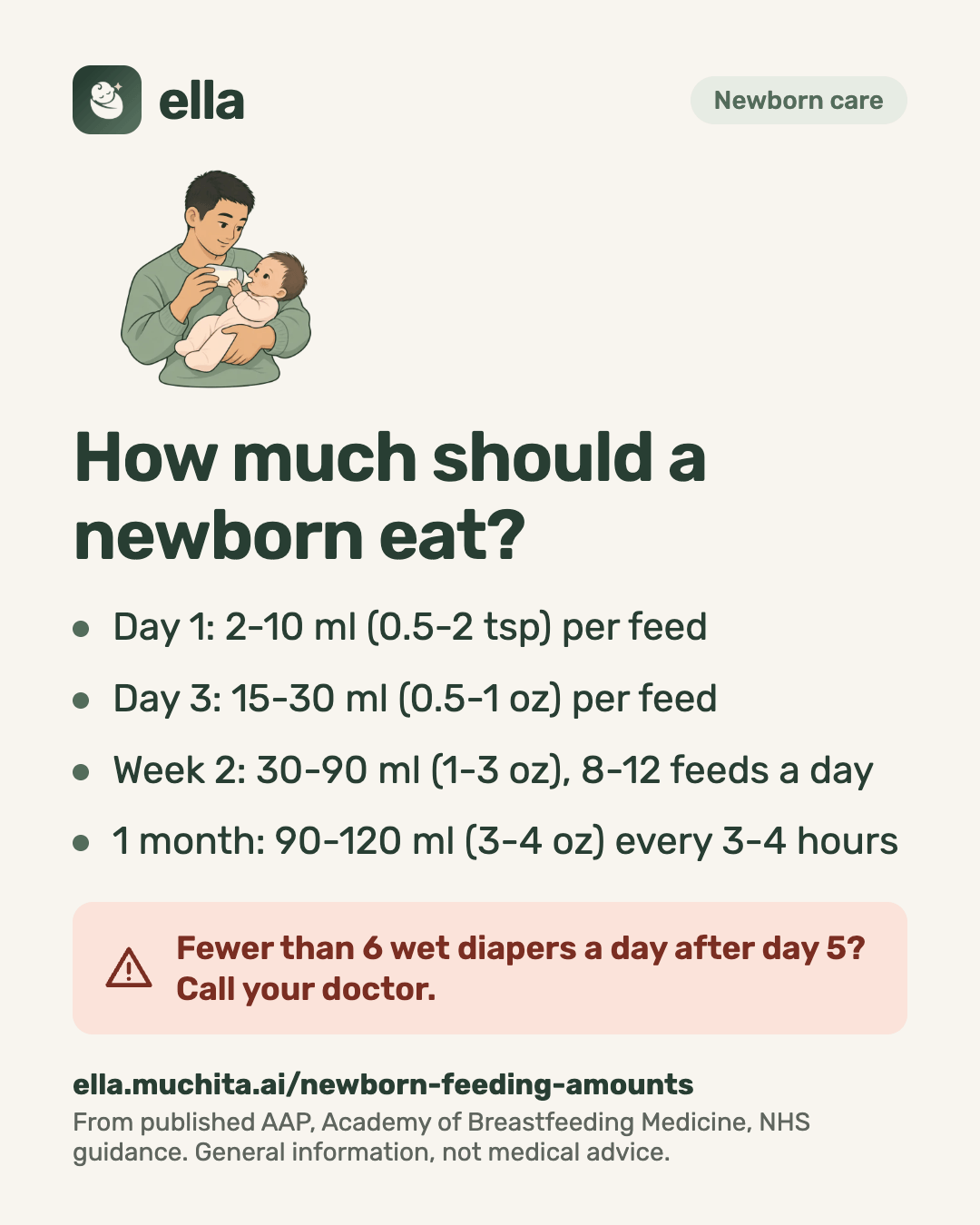
How much should a newborn eat?
Checked against current guidance on October 8, 2026. General information, not medical advice.

The 10-second answer
- Day 1: just 2-10 ml per feed. A newborn's stomach is tiny.317
- By the end of week 1: about 30-60 ml per feed, 8-12 times in 24 hours.2175
- By 1 month: about 90-120 ml per feed, about every 3-4 hours (6-8 feeds a day). Every baby is different: follow hunger and fullness cues.2114
- Breastfed babies: feed whenever they show hunger cues. Count wet diapers, not milliliters.1754
General information from published guidance, not a diagnosis or medical advice for your baby. If you are worried, call your doctor, midwife or local health line, whatever this page says. In an emergency, call your local emergency number.
Amounts for your baby's age
For formula or pumped milk. Every baby is different: follow hunger and fullness cues, not the bottle markings.
Choose by birthday
- Per feed
- 2-10 ml
- Feeds in 24 hours
- 8-12
- Usually every
- 2-3 hours
Colostrum comes in small amounts and is all most babies need. Expect short, frequent feeds and lots of sleep.371
- Per feed
- 5-15 ml
- Feeds in 24 hours
- 8-12
- Usually every
- 2-3 hours
Many babies feed almost nonstop on the second night. This cluster feeding is normal and helps bring in your milk.37
- Per feed
- 15-30 ml
- Feeds in 24 hours
- 8-12
- Usually every
- 2-3 hours
Breast milk often comes in between days 2 and 5. Feeds may suddenly get longer and swallowing louder.37
- Per feed
- 30-60 ml
- Feeds in 24 hours
- 8-12
- Usually every
- 2-3 hours
Expect more wet diapers each day, with at least 6 heavy ones a day from day 5, and poop turning from black to green-brown, then yellow.345
- Per feed
- 30-90 ml
- Feeds in 24 hours
- 8-12
- Usually every
- 2-3 hours
Most babies are back to their birth weight by day 10-14.2183
- Per feed
- 60-120 ml
- Feeds in 24 hours
- 8-10
- Usually every
- 2-4 hours
A growth spurt between 3 and 6 weeks can mean a few days of extra-hungry feeds. It passes.218
- Per feed
- 90-150 ml
- Feeds in 24 hours
- 6-8
- Usually every
- 3-4 hours
A growth spurt is common around 6 weeks. Daily totals usually stay under 960 ml.28
- Per feed
- 120-180 ml
- Feeds in 24 hours
- 6-8
- Usually every
- 3-4 hours
Some babies start dropping a night feed, others don't. Both are normal.2
Formula by weight
See the time since the last feed, and log the next one with one tap, in Ella. Open Ella
If your baby stops breathing, turns blue or grey, is floppy or cannot be woken, call your local emergency number now.
The details
Breastfed or bottle-fed: what changes
You can't see how much a breastfed baby drinks, and you don't need to. Feed whenever your baby shows hunger cues, usually 8-12 times in 24 hours, and let them finish the first breast before offering the second. Bottle-fed babies have amounts printed on the tin, but those are averages. Your baby's cues are the better guide.
Signs your baby is getting enough
Hunger and fullness cues
Early hunger cues are stirring, rooting (turning toward anything that touches the cheek), sucking on hands and smacking lips. Crying is a late cue: calm the baby first, then feed. Fullness looks like slowing down, turning away, releasing the nipple and relaxed, open hands. See the feeding cues, illustrated.
Paced bottle feeding in 5 steps
- Hold your baby fairly upright, head supported.
- Keep the bottle nearly horizontal so milk only just fills the nipple.
- Touch the nipple to the lips and let your baby draw it in.
- After 3-5 swallows (about 20-30 seconds), tip the bottle down for a short pause, then tip it back up when your baby starts sucking again.
- Stop when your baby shows fullness cues, even if milk is left.
Should I wake my newborn to feed?
Growth spurts and cluster feeding
Formula safety in one line
Make formula exactly as the label says: never add extra water or extra powder, and throw away what your baby doesn't finish.
Questions parents ask
How many ounces should a newborn drink?
In the first days, very little: about 2-10 ml (under half an ounce) per feed on day 1, rising to about 1-2 oz (30-60 ml) by days 4-5 and 3-4 oz (90-120 ml) by 1 month. Formula-fed babies usually take about 2.5 oz per pound of body weight per day.321
Can you overfeed a bottle-fed baby?
Yes. Fast-flowing bottles and finishing every last drop can lead to discomfort, spit-up and too much weight gain. Paced feeding and stopping at fullness cues help.113
How long should a breastfeed take?
It varies a lot: anywhere from 10 to 40 minutes is common in the first weeks. Feeds that are regularly shorter than about 10 minutes or longer than about 50 minutes, or a baby who never seems satisfied, are worth checking with a midwife, lactation consultant or doctor.6