Feeding · pumping and storage
How long does breast milk last?
Checked against current guidance on October 8, 2026. General information, not medical advice.
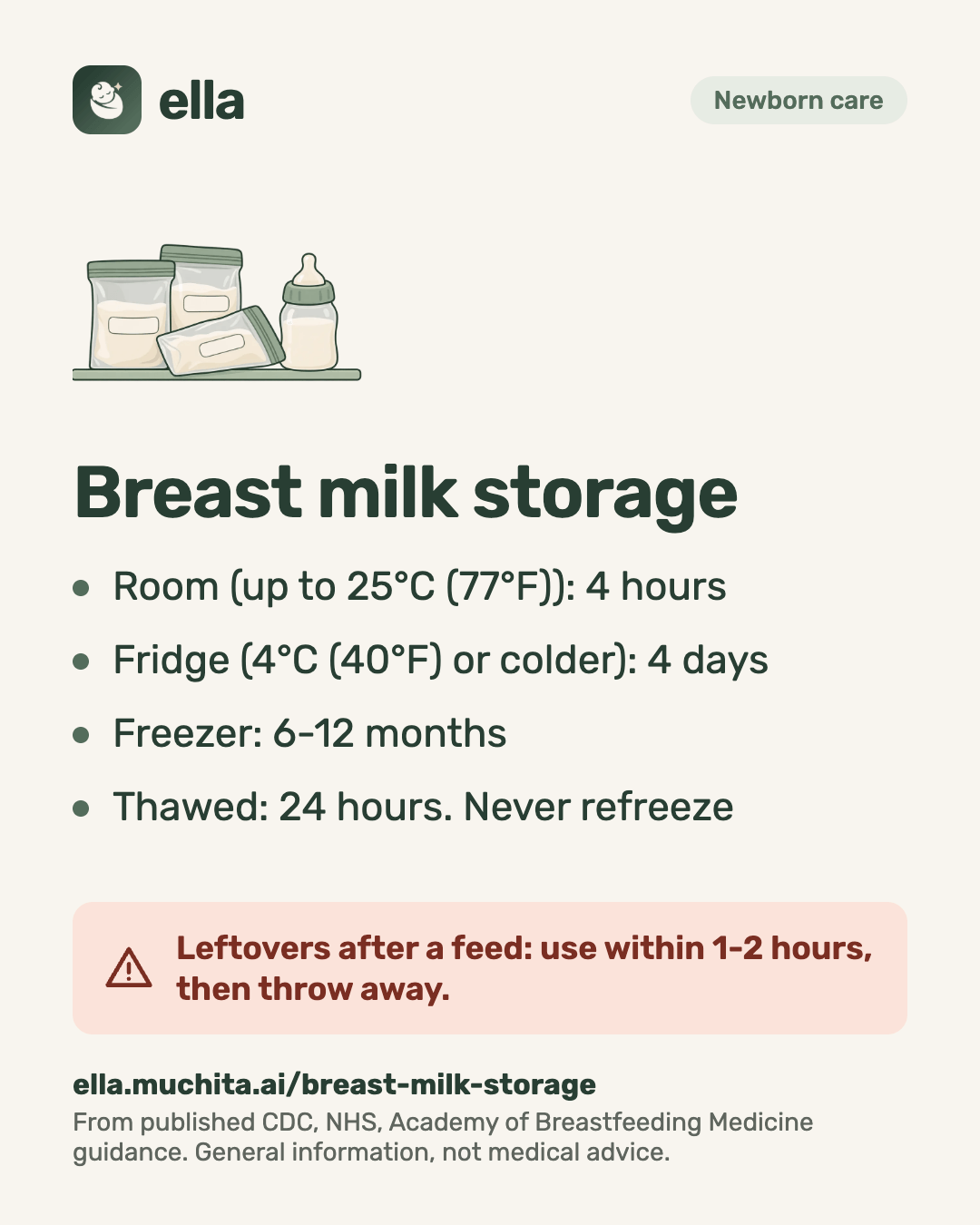
The 10-second answer
General information from published guidance, not a diagnosis or medical advice for your baby. If you are worried, call your doctor, midwife or local health line, whatever this page says. In an emergency, call your local emergency number.
Where is the milk?
For healthy, full-term babies at home. If your baby is premature or in hospital, follow your care team's rules.
- Use within
- 4 hours
- Good to know
- Up to 25°C. Keep it covered and out of the sun.
- Use within
- 4 days
- Good to know
- At the back of the fridge, not in the door, at 4°C or colder.
The NHS allows up to 8 days at 4°C or colder. If you aren't sure how cold your fridge is, use it within 3 days.124
- Use within
- 6 months is best, 12 months acceptable
- Good to know
- At -18°C or colder. Leave room at the top: milk expands.
- Use within
- 24 hours in the fridge, counting from when it is fully thawed
- Good to know
- Once warmed or at room temperature: within 2 hours.
Thawing and warming, step by step
- Step 1 of 5
Use the oldest first
Check the date on the bag or bottle and use the oldest milk first.1
- Step 2 of 5
Thaw slowly
Overnight in the fridge, or in a bowl of warm water, or under lukewarm running water.1234
- Step 3 of 5
Never microwave
Microwaves heat unevenly and can scald your baby's mouth. They can also damage the milk.1234
- Step 4 of 5
Warm gently
Stand the bottle in warm water for a few minutes. Many babies are happy with cool milk too.123
- Step 5 of 5
Swirl and test
Fat separates, which is normal. Swirl gently, then test a few drops on your wrist: it should feel warm, not hot.1
Log each pumping session in Ella, so you always know which milk is oldest. Open Ella
Call your doctor or midwife today if
- your baby vomits or has diarrhea after a feed of stored milk (under 3 months, or with fewer wet diapers: get advice now; in the UK, 111)5
Ask a lactation consultant if
- your supply suddenly drops
- pumping hurts or leaves your breasts sore
- you are not sure how much to pump for your baby
If your baby stops breathing, turns blue or grey, is floppy or cannot be woken, call your local emergency number now.
The details
Storing milk safely
Combining milk from different sessions
You can add newly pumped milk to milk that is already stored. Cool the fresh milk in the fridge first, then add it to milk that is already cold. Label it with the date of the oldest milk and use it within that milk's time limit.
It looks different. Is it OK?
Stored milk separates into a creamy layer and a thinner layer, which is normal: swirl it gently to mix. Refrigerated or thawed milk can smell soapy because of a natural enzyme (lipase). It is still safe, and most babies drink it happily. Throw away milk that has been stored longer than the times above.
Why the guidelines differ by country
The CDC (US) says up to 4 days in the fridge and the NHS (UK) says up to 8 days at 4°C or colder. Both are safe in a cold, clean fridge. When in doubt, use the shorter time. For frozen milk, the CDC says 6 months is best and 12 acceptable; the NHS says up to 6 months. For milk left over after a feed, the CDC says within 2 hours and the NHS says within 1 hour.
Questions parents ask
How long can breast milk stay out at room temperature?
Up to 4 hours at room temperature up to 25°C. After a feed has started, use the leftover within 2 hours (the NHS says 1 hour).1342
How long is breast milk good in the fridge?
Up to 4 days at 4°C or colder (CDC). The NHS allows up to 8 days at 4°C or colder.12
Can I refreeze thawed breast milk?
No. Once breast milk has thawed, use it within 24 hours in the fridge, or within 2 hours once it is warmed or at room temperature.1