Feeding · birth to 12 months
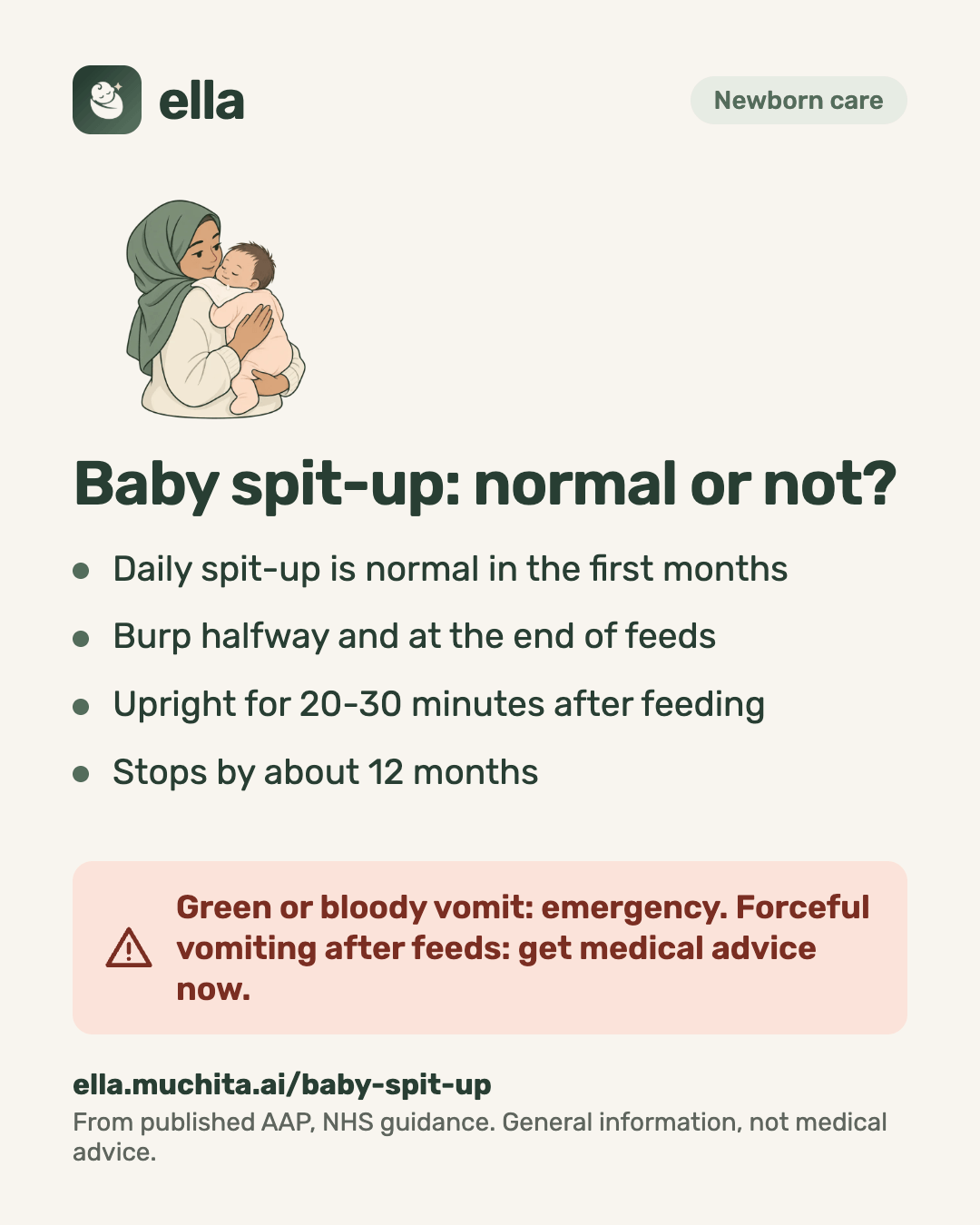
Baby spit-up: normal or not?
Checked against current guidance on October 8, 2026. General information, not medical advice.

The 10-second answer
- Spit-up is normal: at least half of babies spit up every day in the first months.784
- A baby who spits up but is content and growing well needs no treatment. It usually stops by 12 months.1647
- Burp halfway through and at the end of a feed, and keep your baby upright for 20-30 minutes after.216
- Green or bloody vomit: go to an emergency department now. Forceful (projectile) vomiting after feeds, or repeated vomiting under 12 weeks: get medical advice now.7934
General information from published guidance, not a diagnosis or medical advice for your baby. If you are worried, call your doctor, midwife or local health line, whatever this page says. In an emergency, call your local emergency number.
What did you see?
Common signs, and what the guidance says to do
Usually normal
Small, frequent spit-ups in a happy baby are typical, and they usually improve as babies grow.174
Usually normal
A little milk can look like a lot on a cloth. Spit-up in a baby who is content, feeding well and growing is usually not a concern.47
Watch and log it
This may be reflux discomfort or a fast flow. Try smaller, paced feeds and more burping. Talk to your doctor if it happens at most feeds.6111
Guidance: get medical advice now
Especially at 2-8 weeks, forceful vomiting after feeds can be pyloric stenosis, a narrowing at the stomach exit that needs treatment. Get medical advice now: call your doctor right away (in the UK, an urgent GP appointment or 111).7314
Guidance: call emergency services now
Green vomit can mean a blocked gut, which needs treatment fast. Go to an emergency department or call your local emergency number now.7934
Guidance: call emergency services now
Blood in vomit, or vomit that looks like coffee grounds, needs checking straight away: go to an emergency department or call your local emergency number.7934
Guidance: get medical advice now
Babies lose fluid fast. Under 12 weeks, vomiting twice or more (not spit-up) needs checking: get medical advice now. Older babies: call your doctor today, and get help now if there is no wet diaper for 8 hours.394
Guidance: call emergency services now
Call your local emergency number.7
3 burping positions
 Step 1 of 3
Over the shoulder
Hold your baby upright with their chin resting on your shoulder. Support them with one hand and gently pat or rub the back with the other.2
- Step 2 of 3
Sitting on your lap
Sit your baby on your lap facing sideways. Support the chest and chin with one hand, fingers on the jaw, not the throat. Lean them slightly forward and pat the back.2
 Step 3 of 3
Face down across your lap
Lay your baby on their tummy across your knees, head a little higher than the chest and supported. Gently rub or pat the back.2
Log feeds in Ella to see if spit-up follows big feeds. Open Ella
Get medical help now if
- green or yellow-green vomit7934
- blood or coffee-ground-looking vomit394
- your baby is floppy, very sleepy, or has a swollen, hard tummy346
- choking, pauses in breathing or color change during or after feeds7
- forceful (projectile) vomiting after feeds, or repeated vomiting in a baby under 12 weeks7314
- a baby under 1 month who spits up and seems unwell in any way7
Call your doctor or midwife today if
If your baby stops breathing, turns blue or grey, is floppy or cannot be woken, call your local emergency number now.
The details
Why babies spit up
Reflux or reflux disease?
What helps
What not to do
Questions parents ask
Is it normal for a baby to spit up after every feed?
It can be, if your baby is content, feeding well and gaining weight. Talk to your doctor if your baby seems in pain, refuses feeds or isn't growing.467
What's the difference between spit-up and vomit?
Spit-up flows out gently, often with a burp. Vomiting is forceful and shoots out. Repeated forceful vomiting needs a doctor.13
When does spit-up stop?
It usually peaks around 4 months and stops by 12 months, as the muscles mature and your baby sits up and eats solid food.648
Should I feed my baby again after they spit up?
If your baby seems hungry, you can offer a feed. If not, wait until the next feed.12