Crying · first 4 months
Why is my baby crying?
Checked against current guidance on October 8, 2026. General information, not medical advice.

The 10-second answer
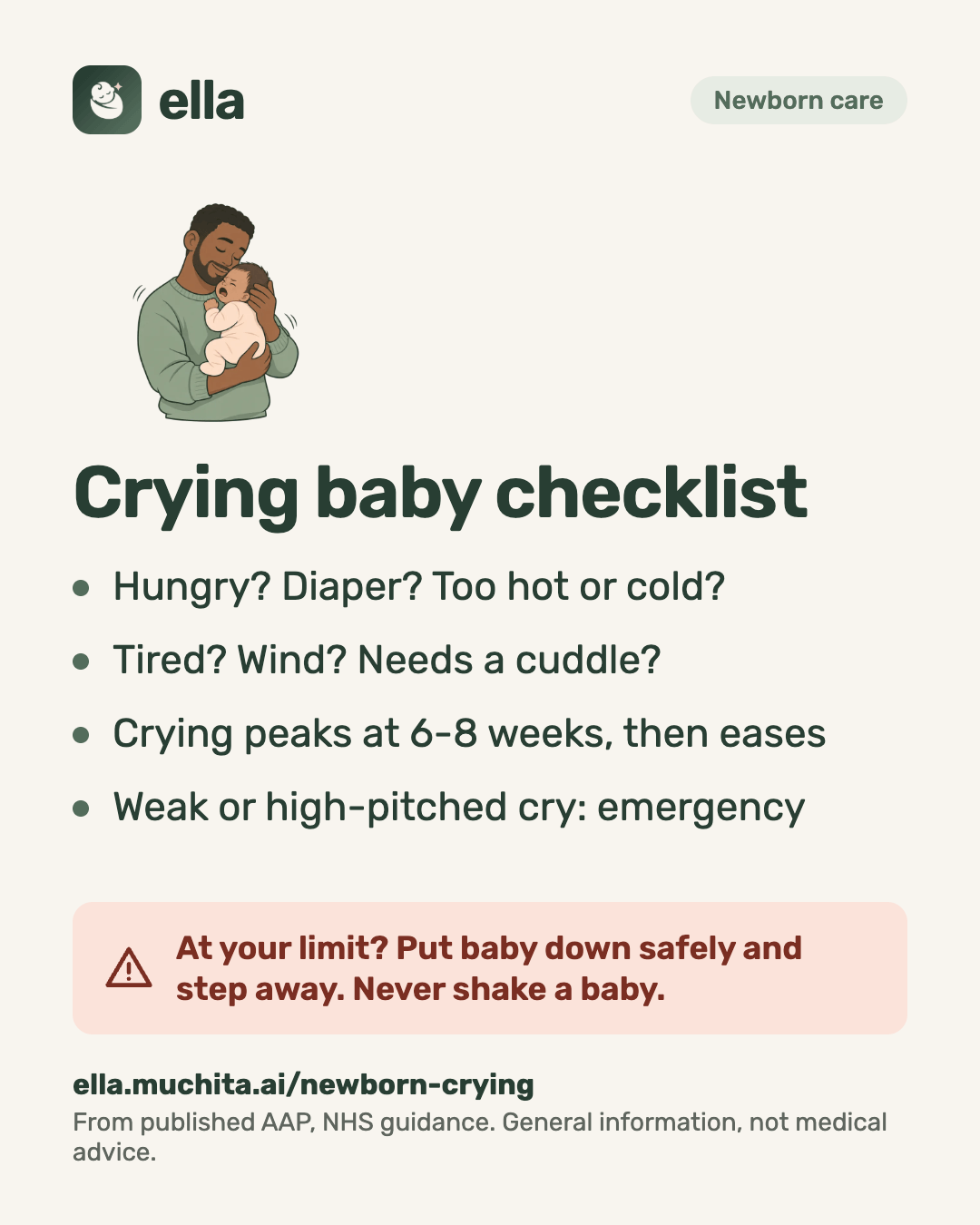
- Check the basics in order: hungry, diaper, too hot or cold, tired, wind, needs a cuddle.13
- Crying increases from about 2 weeks, peaks around 6-8 weeks and eases by 3-4 months. That is normal.235
- At your limit? Put your baby on their back in the crib and step away for a few minutes. Check on them every 5-10 minutes. Never shake a baby.1357
- A weak, high-pitched or very different cry: call your local emergency number now. Crying with a temperature of 38°C or more under 3 months: get medical help now.148
General information from published guidance, not a diagnosis or medical advice for your baby. If you are worried, call your doctor, midwife or local health line, whatever this page says. In an emergency, call your local emergency number.
The calm-down checklist
- Step 1 of 8
Hungry?
Look for rooting, hands to mouth or lip smacking. If you are breastfeeding, offer the breast even if it has not been long since the last feed.13
- Step 2 of 8
Diaper?
Check for a wet or dirty diaper, and for diaper tabs or clothes that are too tight.16
- Step 3 of 8
Too hot or too cold?
Feel the back of the neck or the tummy. Sweaty means remove a layer, cool means add one. Hands and feet are usually cooler and don't tell you much.19
- Step 4 of 8
Wind?
Hold your baby upright against your shoulder or sitting on your lap and gently pat or rub the back for a minute or two.134
- Step 5 of 8
Tired?
Tiredness is one of the most common reasons for crying. Dim the lights, cut the noise, and try rocking, a pacifier or a snug swaddle if your baby isn't rolling yet.123
- Step 6 of 8
Needs you?
Skin-to-skin contact, a baby carrier, a slow walk, gentle shushing or steady white noise can all help.1235
- Step 7 of 8
Something else?
Look for a hair wrapped tightly around a finger or toe, clothing that is rubbing, or signs of illness. Take your baby's temperature.16
- Step 8 of 8
Still crying?
Some crying can't be fixed, and that is not your fault. Put your baby safely on their back in the crib, close the door and take a few minutes. Check on your baby every 5-10 minutes. Call someone you trust to take over if you can.1357
Is this cry a worry?
Common signs, and what the guidance says to do
Guidance: call emergency services now
A fever at this age always needs checking straight away: call your local emergency number or go to an emergency department. If your baby otherwise seems well, you can call your doctor's urgent line right away instead (in the UK, 111).1814
Guidance: call emergency services now
A weak, high-pitched or constant cry, or one that doesn't sound like your baby's usual cry, can be a sign of serious illness. Call your local emergency number or go to an emergency department now.348
Log feeds, sleep and diapers in Ella to spot what's behind the fussy hours. Open Ella
Get medical help now if
If your baby stops breathing, turns blue or grey, is floppy or cannot be woken, call your local emergency number now.
The details
The normal crying curve
Healthy babies cry more and more from about 2 weeks old, with a peak around 6-8 weeks and a big improvement by 3-4 months. This normal peak in crying is the focus of the Period of PURPLE Crying® program from the National Center on Shaken Baby Syndrome, which is not affiliated with Ella. Crying is often worst in the late afternoon and evening, and sometimes nothing seems to help. Knowing this curve won't stop the crying, but it helps to know it ends.
What is colic?
Calming moves that often work
It's OK to walk away
Constant crying is exhausting, and feeling angry or desperate doesn't make you a bad parent. If you feel you can't cope, put your baby on their back in a safe crib, close the door and take a break. Shaking a baby, even for a second, can cause serious brain injury. Make sure everyone who cares for your baby knows this.
Colic remedies
Look after yourself too
Thoughts of harming yourself or your baby are an emergency: call your local emergency number now. Postpartum depression is common and treatable, and fathers and partners can have it too. If you have felt low, hopeless or anxious for more than 2 weeks, talk to your doctor, midwife or health visitor soon.
Questions parents ask
How long is it normal for a newborn to cry?
Around 1-3 hours a day in total is common in the first 3 months, with a peak at 6-8 weeks. Crying that is much more, or sounds different, is worth checking with your doctor.267
Can I spoil a newborn by holding them too much?
No. Newborns can't be spoiled. Holding and comforting your baby helps them feel safe and often reduces crying.6