ella by Muchita
Choose language: EnglishEnglishEN
Newborn care Start free

Play and development · birth to 6 months

Tummy time: how much, by age

Checked against current guidance on October 8, 2026. General information, not medical advice.

Illustration of a baby doing tummy time face to face with a parent.

The 10-second answer

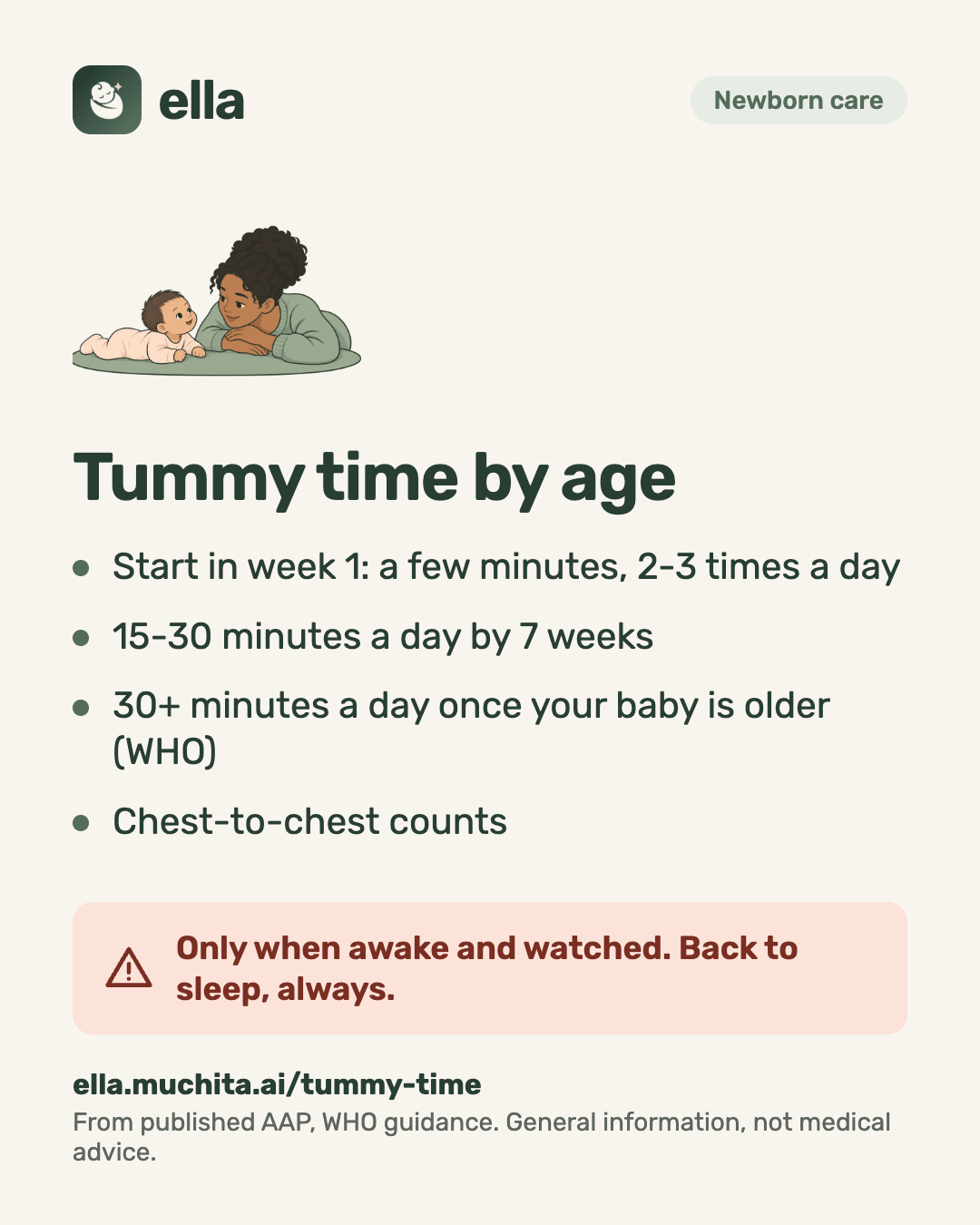
  • Start in the first days at home: a few minutes (3-5), 2-3 times a day, while your baby is awake and you are watching.1
  • Aim for 15-30 minutes in total a day by about 7 weeks, and 30 minutes or more once your baby is older (WHO).12
  • Chest-to-chest on you counts. Short and often beats long and tearful.134

General information from published guidance, not a diagnosis or medical advice for your baby. If you are worried, call your doctor, midwife or local health line, whatever this page says. In an emergency, call your local emergency number.

Tummy time for your baby's age

Choose by birthday
Daily total
About 10-15 minutes
Each session
3-5 minutes
You may notice
Lifting the head briefly to look at you

Chest-to-chest on an awake, reclined adult, or across your lap, is perfect at this age.13

Daily total
Building to 15-30 minutes
Each session
3-5 minutes
You may notice
Lifting the head briefly

Try after a diaper change, when your baby is awake and not too full.16

Daily total
30 minutes or more
Each session
Several short sessions
You may notice
Holding the head up; pushing up on forearms by about 4 months

Put a toy or a mirror in front to make it interesting.126

Daily total
30-60 minutes or more
Each session
10-15 minutes or longer
You may notice
Pushing up on straight arms, reaching, rolling

Lots of floor time now helps with rolling, sitting and crawling.2346

Tummy time timer

0:00

Total today: 0:00

Positions to try

  1. An awake father reclines against pillows with his newborn lying tummy-down on his chest, their faces close together.Step 1 of 4

    Chest to chest

    Lie back, propped up, with your baby on your chest. Your face is the best toy there is. Only do this while you are wide awake: if you feel sleepy, put your baby on their back in their crib.13

  2. A mother sits cross-legged with her baby lying tummy-down across her lap, one hand resting on the baby's back as it lifts its head.Step 2 of 4

    Across your lap

    Lay your baby tummy-down across your knees, with a hand on the back. Gently rock your knees.3

  3. A baby lies on its side on a play mat, supported by a rolled blanket behind its back, face to face with its father lying beside it.Step 3 of 4

    Side-lying

    If your baby doesn't like their tummy yet, lay them on their side on a blanket on the floor, with a rolled-up towel behind their back for support. Stay with them.3

  4. A baby on its tummy on a play mat lifts its head to look at a soft-framed baby mirror standing in front of it.Step 4 of 4

    Floor with a mirror

    Lie down face to face, or put an unbreakable mirror in front of them.1

On Android, Ella's widget runs a tummy time timer from your lock screen and adds up the day. Open Ella

Call your doctor or midwife today if

  • your baby always turns the head to the same side, or the head is getting a flat spot45
  • your baby can't lift the head at all by 3 months67
  • your baby's muscles seem very stiff, or very loose like a rag doll, during play. A baby who is suddenly floppy or hard to wake needs emergency help.7

If your baby stops breathing, turns blue or grey, is floppy or cannot be woken, call your local emergency number now.

The details

Why tummy time matters

Babies sleep on their backs, which is the safe way to sleep. Tummy time while awake builds the neck, shoulder and arm strength needed for rolling, sitting and crawling, and helps prevent flat spots on the back of the head.

14

If your baby hates it

Many do at first. Try shorter sessions more often, get down to their level, use chest-to-chest time, sing, and pick a time when your baby isn't hungry or tired. A few minutes at a time adds up.

134

Safety

Tummy time is for when your baby is awake and someone is watching. If your baby falls asleep on their tummy, turn them onto their back and move them to their own sleep space.

13

Flat spots

A flat spot can appear if a baby spends a lot of time lying in the same position. Tummy time, holding your baby upright, and switching which end of the crib their head is at all help. Talk to your doctor if the flat spot is getting worse.

145

Questions parents ask

When should I start tummy time?

From the first days at home, once your baby is awake and alert. Chest-to-chest time counts.13

How much tummy time does a newborn need?

Start with a few minutes (3-5), 2-3 times a day, and build up to 15-30 minutes in total a day by around 7 weeks.1

Does chest-to-chest count as tummy time?

Yes. Your baby is lifting their head and using the same muscles, and they get to look at you.13

What if my baby falls asleep during tummy time?

Gently roll them onto their back and move them to a safe sleep space.3

Ella

A tummy time timer that keeps count

Start tummy time in Ella with one tap. On Android the timer shows on your lock screen, and Ella adds up the day's total for every caregiver.

Sources

  1. AAP, HealthyChildren.org: Back to sleep, tummy to play
  2. WHO guidelines on physical activity, sedentary behaviour and sleep for children under 5 (2019)
  3. AAP, HealthyChildren.org: 3 tummy time activities to try with your baby
  4. AAP, HealthyChildren.org: Flat head syndrome (positional skull deformities) and torticollis
  5. NHS: Flat head syndrome (plagiocephaly and brachycephaly)
  6. CDC Learn the Signs. Act Early.: Milestones at 2, 4 and 6 months (2022 checklists)
  7. AAP, HealthyChildren.org: Is your baby's physical development on track?

Guidance can differ between countries. Where it does, we show both. Follow your own doctor or health service.

Checked against current guidance on October 8, 2026. General information, not medical advice. Written by the Ella team at Muchita AI from published guidance by the AAP, NHS, NICE, WHO and CDC, with AI-assisted drafting and translation checked against those sources by our team. These organisations have not reviewed or endorsed this page. General information, not a diagnosis or medical advice. If you are worried about your baby, trust your instinct and call a doctor.

How we write these guides · Report an error

When to call