Feeding · bottles
How to make baby formula safely
Checked against current guidance on October 8, 2026. General information, not medical advice.
The 10-second answer
- Follow the tin exactly: water first, then level scoops. Never add extra water or extra powder.312
- For young babies, use water boiled and cooled to no less than 70°C, then cool the bottle quickly.321
- Use a made-up bottle within 2 hours, or within 1 hour once your baby starts drinking.12
- Throw away whatever your baby doesn't finish.321
General information from published guidance, not a diagnosis or medical advice for your baby. If you are worried, call your doctor, midwife or local health line, whatever this page says. In an emergency, call your local emergency number.
Make a bottle, step by step
- Step 1 of 6
Clean hands, clean bottle
Wash your hands. Bottles, nipples and rings should be washed and, for young babies, sterilized.231
- Step 2 of 6
Boil fresh water
Boil fresh tap water and let it cool for no more than 30 minutes, so it is still at least 70°C. Hot water kills germs that can be in powdered formula.32
- Step 3 of 6
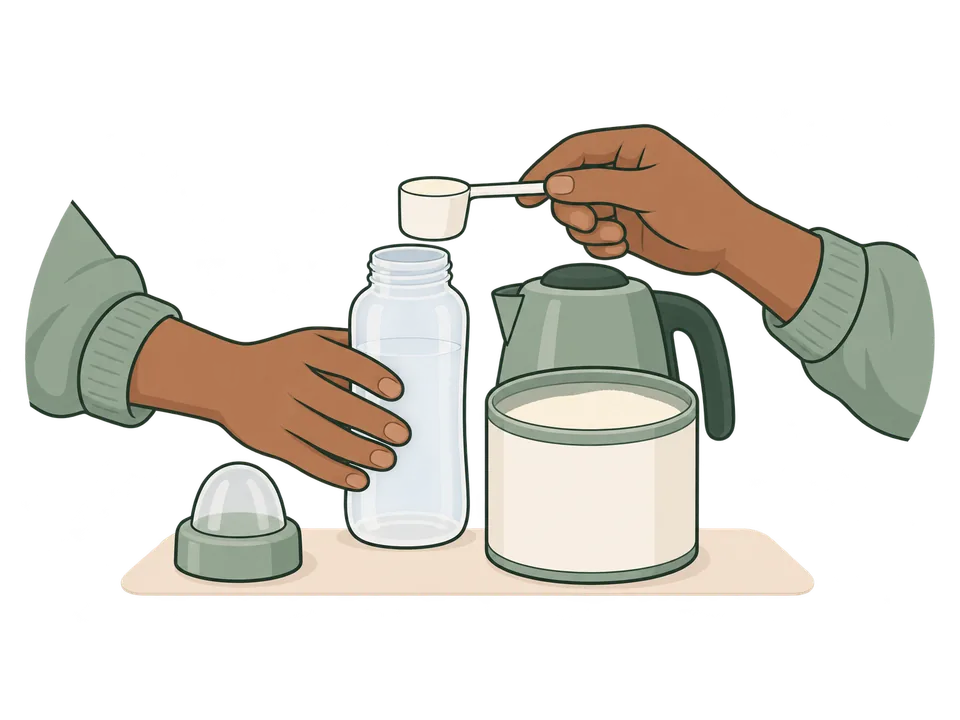
Water first
Pour the amount of water the tin says into the bottle. Check the level at eye height.31
- Step 4 of 6
Level scoops
Use the scoop from the tin, level it with the leveler or a clean knife, and add the exact number of scoops.32
- Step 5 of 6
Shake and cool
Put the cap on and shake well. Cool under cold running water until it feels lukewarm on the inside of your wrist.32
- Step 6 of 6
Feed, then throw away the rest
Feed within 2 hours of making it, and finish within 1 hour of starting. Throw away any leftover milk.123
How long does a bottle keep?
- Use within
- 2 hours
- Good to know
- After making it.
If you won't use it within 2 hours, cool it and put it in the fridge right after making it. Once a bottle has been out for 2 hours, throw it away.21
- Use within
- 1 hour
- Good to know
- Then throw away what's left.
- Use within
- 24 hours
- Good to know
- At 4°C or colder, at the back, not in the door.
Many health services prefer making each bottle fresh. If you make bottles ahead, cool them quickly and refrigerate at once.213
- Use within
- Follow the label
- Good to know
- Once opened, cover it, keep it in the fridge and use it within the time on the label.
Ready-to-feed formula is sterile until opened, which is handy at night and when traveling.2
Log the bottle and amount in Ella with one tap, and see today's total. Open Ella
If your baby stops breathing, turns blue or grey, is floppy or cannot be woken, call your local emergency number now.
The details
Why the exact amounts matter
Water
Use fresh tap water that has been boiled once. The NHS (UK) does not recommend bottled water: it isn't sterile and may contain too much salt (sodium) or sulphate, so use it only if your tap water is unavailable or unsafe, and still boil it. In the US, the CDC says safe tap water is usually fine for formula. Don't use softened water.
Night feeds and travel
Ready-to-feed liquid formula or a thermos of just-boiled water (kept above 70°C) make night feeds and outings easier. Don't carry made-up warm bottles for hours.
Warming
Questions parents ask
Do I need to boil water for formula?
Most health services advise boiling fresh tap water and using it at 70°C or hotter when making powdered formula, especially for babies under 2 months, premature babies and babies with weak immune systems.321
Can I make formula bottles in advance?
It's safest to make each bottle fresh. If you do make them ahead, cool quickly, refrigerate at once and use within 24 hours.213
How long can formula sit out?
Up to 2 hours after making it, and up to 1 hour once your baby has started drinking. Then throw it away.12
Can I reheat a bottle?
No. Warm it once, use it, and throw away what's left.2