Feeding · first weeks
How to get a good breastfeeding latch
Checked against current guidance on October 8, 2026. General information, not medical advice.

The 10-second answer
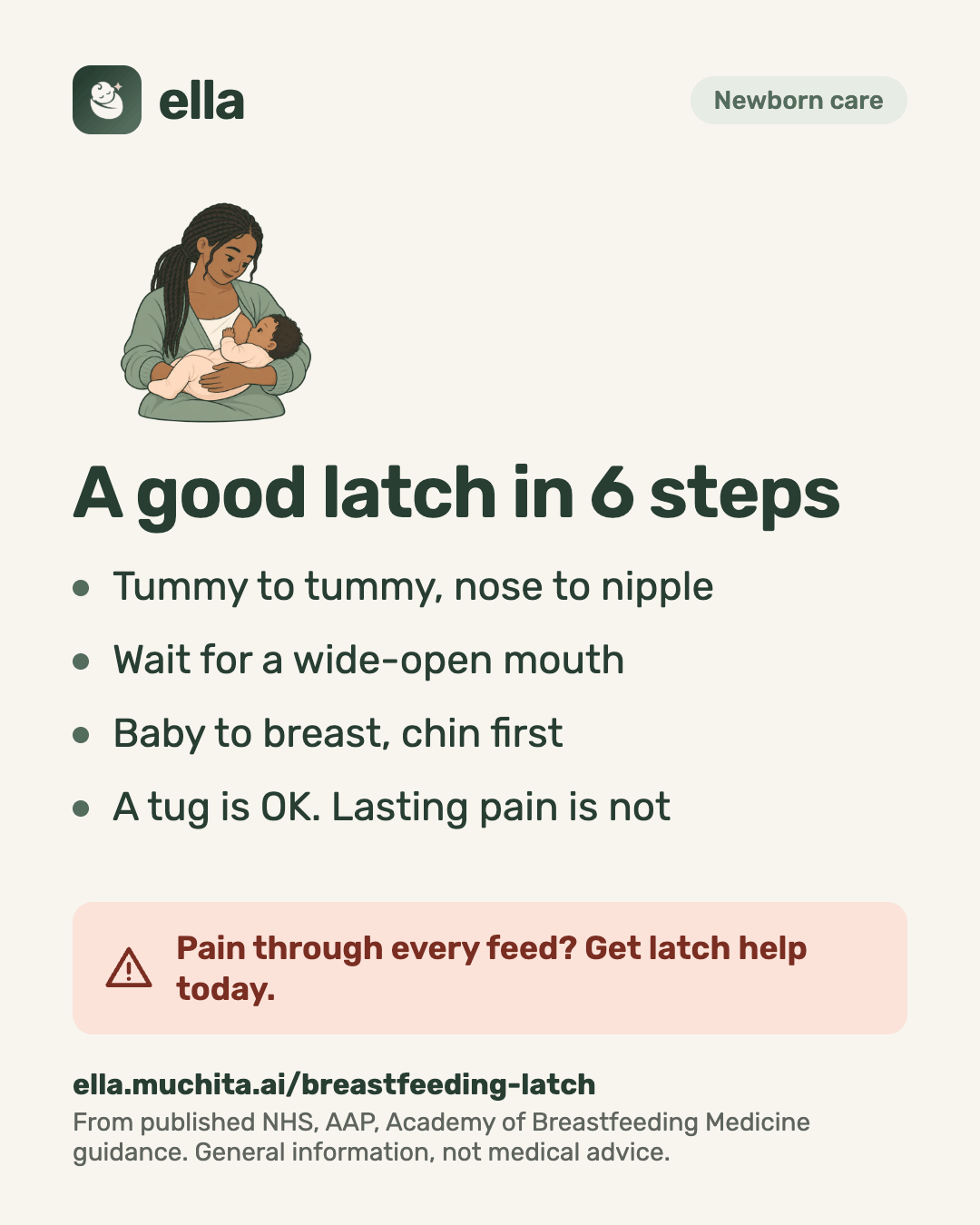
- Tummy to tummy, nose to nipple: bring your baby to the breast, not the breast to your baby.123
- Wait for a wide-open mouth, then bring your baby in quickly, chin first.12
- A good latch may tug, but it shouldn't keep hurting after the first 30-60 seconds.25
- Pain that lasts, cracked nipples or a baby who never seems full: ask for help early.612
General information from published guidance, not a diagnosis or medical advice for your baby. If you are worried, call your doctor, midwife or local health line, whatever this page says. In an emergency, call your local emergency number.
Latch in 6 steps
- Step 1 of 6
Get comfortable
Sit back with support for your back and arms. Have water nearby. A pillow can bring your baby up to breast height.13
 Step 2 of 6
Tummy to tummy
Hold your baby close, facing you, with their ear, shoulder and hip in a line. Their head should be free to tilt back.123
- Step 3 of 6
Nose to nipple
Line your nipple up with your baby's nose, so they tilt their head back slightly to reach it.1
 Step 4 of 6
Wait for wide
Brush the nipple against the top lip and wait for a big, wide-open mouth, like a yawn.12
 Step 5 of 6
Bring baby in, chin first
Move your baby (not your breast) onto the breast, chin and lower lip first, taking in a big mouthful of the darker area below the nipple.12
- Step 6 of 6
Check and adjust
Lips flipped out, chin touching the breast, cheeks round. If it pinches, slide a clean finger into the corner of the mouth to break the suction and try again.125
How does the latch feel?
Common signs, and what the guidance says to do
Usually normal
A strong tug that eases into comfort is what a good latch usually feels like. You should hear or see swallowing after the first few quick sucks.15
Watch and log it
Common in the first days. If it keeps happening after the first week, ask a midwife or lactation consultant to check the latch.26
Guidance: call your doctor today
Pain that lasts through the feed often means the latch is too shallow. Break the suction and try again with a wider mouth. If it keeps hurting, get help today: early help prevents damage.26
Watch and log it
A sign of a shallow latch. Aim the nipple higher, toward the roof of the mouth, and bring your baby in chin first.562
Watch and log it
Your baby may be losing suction. Try a new latch. If it happens every feed, ask about tongue-tie at your next check.27
Ella remembers which side is next and times each breast, from one tap on the widget. Open Ella
If your baby stops breathing, turns blue or grey, is floppy or cannot be woken, call your local emergency number now.
The details
Positions to try
- Cradle hold: your baby lies across your lap, head in the crook of your arm.
- Cross-cradle: like the cradle, but you support the head with the opposite hand. Great for learning.
- Football (rugby) hold: your baby is tucked under your arm along your side. Comfortable after a C-section.
- Laid-back: you recline and your baby lies tummy-down on you. Babies often latch by themselves this way.
- Side-lying: both of you lie on your sides, facing each other. Move your baby back to their own sleep space if you feel sleepy.
How long and how often
Signs breastfeeding is going well
Swallowing you can hear, a baby who seems content after most feeds, soft breasts after feeding, at least 6 heavy wet diapers a day from day 5, and yellow poop. Our diaper guide has the day-by-day numbers.
Questions parents ask
How do I know my baby is latched properly?
Your baby's mouth is wide open with lips flipped out, chin touching the breast, cheeks rounded, and you hear swallowing. It may tug, but it shouldn't keep hurting.125
Is breastfeeding supposed to hurt?
Some tenderness in the first days is common, but pain that lasts the whole feed is not normal. It usually means the latch needs adjusting.26
What is the best breastfeeding position for a newborn?
There's no single best one. Cross-cradle and football holds give you the most control while learning; laid-back feeding lets your baby lead.3
Can tongue-tie cause latch problems?
Sometimes. If feeding stays painful or your baby can't stay latched despite good technique, ask your doctor or a lactation consultant to check.7