Diapers · first year
Diaper rash: what helps, and when to call
From AAP and NHS guidance. Each recommendation links to its source.
The 10-second answer
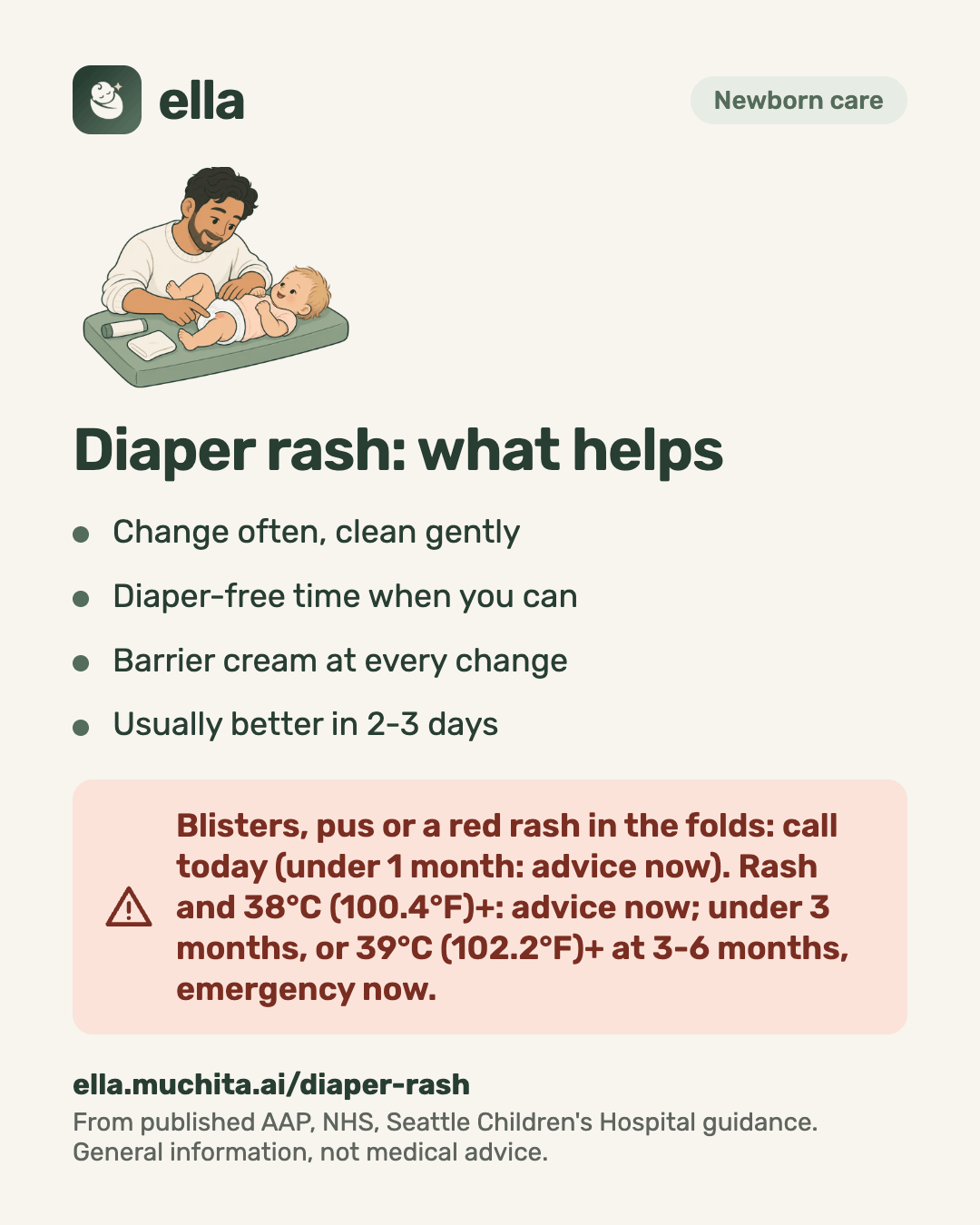
- Most diaper rash comes from wet or dirty skin and usually improves within 2-3 days of good care.[1, 3]
- Change wet or dirty diapers quickly, clean gently with water, give diaper-free time, and put on a barrier cream with zinc oxide or petroleum jelly at every change.[1, 2, 3, 7]
- Not better in 2-3 days, a bright red rash in the folds, or blisters or pus: call your doctor, nurse or midwife today. Under 1 month: get medical advice now.[1, 3]
- Rash with 38°C or higher: get medical advice now. Under 3 months, or 39°C or higher at 3-6 months with no recent vaccine: go to the emergency department now.[8, 4, 9]
Not sure which list a sign fits? Act on the more urgent one.
Call your local emergency number or go to the emergency department now if
- your baby is under 3 months and has a temperature of 38°C or higher, even if they seem well (in the UK, after the 8- or 12-week vaccines, see the fever guide): go to the emergency department now (call your emergency number if your baby looks unwell or you cannot get there safely)[4, 9]
- your baby is 3 to 6 months old with a temperature of 39°C or higher and has not had a vaccine in the past 2 days: go to the emergency department now (call your emergency number if your baby looks unwell)[4, 9]
- there is a rash that does not fade when you press a glass against it[4, 5]
- your baby has a temperature and is not interested in feeding or in what is around them[8]
Get medical advice now (your doctor, a nurse line, or NHS 111 in the UK) if
- your baby has a rash and a temperature of 38°C or higher (3 months or older, below the emergency thresholds above), or seems very sick[8, 3, 1, 4]
- bright red skin is peeling off in sheets[3]
- your baby is under 1 month old and has blisters, a group of pimples or pus spots, yellow crusts or spreading redness anywhere on the skin, or seems unwell or not themselves in any way[3, 10]
Can't reach anyone quickly? Go to urgent care or the emergency department.
Call your doctor, nurse or midwife today if
- there is a bright red rash in the skin folds, with small red spots at the edges[1, 3]
- your baby is 1 month or older and has pimples, blisters, pus, or oozing, crusty or bleeding sores[1, 3]
- the rash isn't better after 2-3 days of care, or is getting worse[1, 2, 3]
- the rash seems very painful, or your baby seems very uncomfortable[1, 2]
If your baby stops breathing, turns blue, grey or blotchy, is floppy or cannot be woken, call your local emergency number now (for example 911 in the US, Canada, Mexico and the Philippines, 999 in the UK and Bangladesh, 112 or 999 in Ireland, 112 or 108 for an ambulance in India, 1122 or 115 in Pakistan, 112 in Europe, Türkiye and Nigeria and from mobiles in South Africa, 112 or 119 in Indonesia, 115 in Vietnam, 192 in Brazil, 000 in Australia, 111 in New Zealand, 995 in Singapore, 101 in Israel; elsewhere, your local ambulance number). Put the phone on speaker: the call handler can talk you through baby CPR.
All emergency signs, for any baby
- is struggling to breathe, grunting with every breath, or is not breathing normally; do not wait to time a pause (short pauses under 10 seconds in sleep, with normal colour, are normal)[11, 12, 13]
- has blue, grey, pale or blotchy skin, lips or tongue[9]
- has swollen lips, tongue or throat and trouble swallowing[4]
- is floppy, not responding like usual, not feeding, very hard to wake, or more sleepy than usual[9]
- has a weak, high-pitched or continuous cry, or a cry that does not sound like their normal cry[14, 4, 9]
- has a high temperature and is extremely agitated, cannot stop crying, or seems confused[8]
- has a seizure (fit)[9, 8]
- has a bulging soft spot on top of their head, or a stiff neck[5, 8]
- has a rash that does not fade when you press a glass against it[9, 8, 15]
- is under 3 months old with a temperature of 38°C or higher, even if they seem well: go to the emergency department now (call if your baby looks unwell or you cannot get there safely; in the UK, after the 8- or 12-week vaccines, see the fever guide)[9, 4]
- is 3 to 6 months old with a temperature of 39°C or higher and has not had a vaccine in the past 2 days: go to the emergency department now (call if your baby looks unwell)[4]
- has a temperature of 36°C or lower, feels cold, damp or clammy to the touch, or is shivery, or has a high temperature with unusually cold hands and feet[4, 9, 8]
- has had no wet diaper for 12 hours or more[9, 4]
- has green or yellow-green vomit, vomits blood, or has vomit that looks like ground coffee[16, 17]
- has yellow skin or eyes in the first 24 hours after birth[18, 19]
Call your local emergency number now, or go straight to the emergency department.[9, 20]
Learn these before you ever need them: Baby CPR[21] · What to do if your baby is choking[22]
These guides explain official guidance; they cannot examine your baby. If you are worried, call your doctor, midwife or health line, whatever the page says. In an emergency, call your local emergency number.
What does the rash look like?
Common signs, and what the guidance says to do
Usually normal
This looks like irritant diaper rash, the most common kind. The steps below usually help within 2-3 days.[1, 3]
Guidance: call your doctor, nurse or midwife today
This may be a yeast (candida) rash, which often follows antibiotics or a rash that hasn't cleared in 3 days. Wash your hands well before and after changes. Your baby may need an antifungal cream: call your doctor, nurse or midwife today.[1, 3, 2]
Guidance: call your doctor, nurse or midwife today
Raw skin is sore and can get infected, and shiny bright red skin can be yeast. Rinse with water from a squirt bottle instead of wiping, pat dry, and put on plenty of barrier cream. Then call your doctor, nurse or midwife today.[1, 3]
Guidance: call your doctor, nurse or midwife today
This may be a skin infection, which needs to be checked and treated. Under 1 month: get medical advice now. From 1 month: call your doctor, nurse or midwife today.[1, 3, 10]
Guidance: get medical advice now
Bright red skin peeling in sheets can be a serious skin infection. Under 1 month, blisters, a group of pimples or pus spots, or yellow crusts anywhere on the skin need a check straight away: get medical advice now.[3, 10]
Guidance: call your emergency number or go to the emergency department now
At 3 to 6 months, after any vaccine in the past 2 days, see the fever guide. Otherwise, even if your baby seems well: go to the emergency department now (call your emergency number if your baby looks unwell or you cannot get there safely).[4, 9]
5 steps that can help
- Step 1 of 5
Change often
Change wet or dirty diapers as soon as you can, including once at night if the rash is bad.[1, 2, 3]
- Step 2 of 5
Clean gently
Use warm water, or fragrance-free, alcohol-free wipes. If the skin is sore, rinse with water instead of wiping. Pat dry gently.[1, 2]
- Step 3 of 5
Air time
Leave the diaper off when you can, with your baby lying on a towel or changing mat.[2, 3, 7]
- Step 4 of 5
Barrier cream
Apply a fragrance-free zinc oxide or petroleum jelly cream at every change. AAP: a thick layer, like icing on a cupcake, adding more on top if it isn't soiled. NHS: a pharmacist may suggest a thin layer at each change.[1, 2]
- Step 5 of 5
Loosen up
Use absorbent diapers that fit well and aren't too tight, especially overnight.[1, 2, 3]
Add a dated rash note to a diaper entry in Ella, to show your doctor. Open Ella
The details
Why diaper rash happens
Products to avoid
Cloth or disposable?
Rash and a temperature
NHS: a rash along with a temperature of 38°C or higher needs medical advice now (in the UK, call 111). Under 3 months, a temperature of 38°C or higher means: go to the emergency department now (call your emergency number if your baby looks unwell or you cannot get there safely). So does 39°C or higher at 3 to 6 months with no vaccine in the past 2 days (NHS's urgent-help page says 999 or A&E; its fever page says 111. We show the stricter advice). See the baby fever guide for what each temperature means at your baby's age.
Questions parents ask
How long does diaper rash last?
With good care, most diaper rash improves in 2-3 days. If it doesn't, or gets worse, call your doctor, nurse or midwife today.[1, 3]
What is the best cream for diaper rash?
A fragrance-free barrier cream with zinc oxide or petroleum jelly, at every change. The ingredients matter more than the brand. Antifungal creams are only for yeast rash, on the advice of a doctor or pharmacist.[1, 2]